PLOAM Messaging Decoder
The PLOAM (Physical Layer Operations, Administration, and Maintenance) message channel is used for essential control and management tasks, including:
-
Activation and registration of ONUs/ONTs
-
Ranging and timing adjustment
-
Power control
-
Encryption key handling
-
Alarm reporting for fault detection
The FX120 captures and decodes downstream Physical Layer Operations, Administrations and Maintenance (PLOAM) messages sent from the OLT to the ONUs/ONTs, providing visibility into the activation status, deactivation/rogue handling, and other key control events that are in a response to upstream ONU behavior.
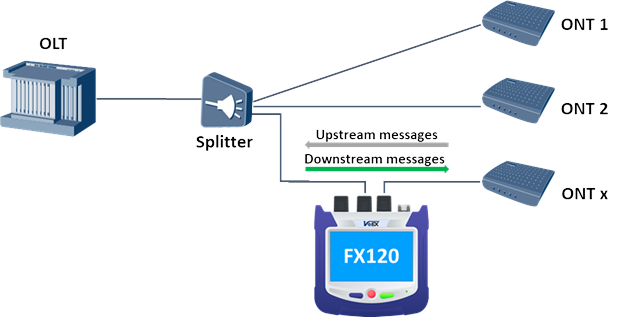
Downstream vs. Upstream Messages
-
Downstream messages (OLT → ONU): These are used to manage groups or individual ONTs. They include activation, configuration, ranging, power control, and alarm instructions.
The FX120 decodes downstream PLOAM messages, including ONT disconnect commands, thus aiding in troubleshooting when the activation or registration process fails.
-
Upstream messages (ONU → OLT): These provide management information from the ONT, such as serial number, password, status updates, and equipment error reports. Upstream PLOAM messages can only be transmitted in allocated upstream slots and when enabled by the OLT (via control fields such as the PLOAMu flag in the downstream). The FX120 does not directly see the upstream PLOAM messages, but it can see the downstream responses and control actions the OLT sends as a result, i.e., assigning ONU-ID, deactivating an ONT, or sending emergency stop messages.
Burst Profiles
Burst profile information is sent at regular intervals, usually every few hundred milliseconds or more. Because these definitions can change, each ONU updates to the latest version whenever a new Burst_profile message arrives. To keep everything synchronized, the OLT waits until all ONUs have received the updated burst profile at least twice while in the ActiveFree or ActiveHeld state before using the new information.
Burst profile data does not carry over when an ONU is reactivated. A newly activated ONU can only respond to a Serial_Number grant once it has received the associated burst profile. As a rule, an ONU can respond to any allocation structure only if it already has the required burst profile definition.
The OLT also needs to consider how broadcast and unicast Burst_Profile messages interact. A broadcast message will overwrite all unicast profiles that share the same burst profile index.
If burst profiles are missing, out of sync or overwritten unexpectedly, ONUs may fail to register properly or experience unstable upstream transmission, leading to intermittent service issues that are difficult to troubleshoot in the field.
View PLOAM Messages
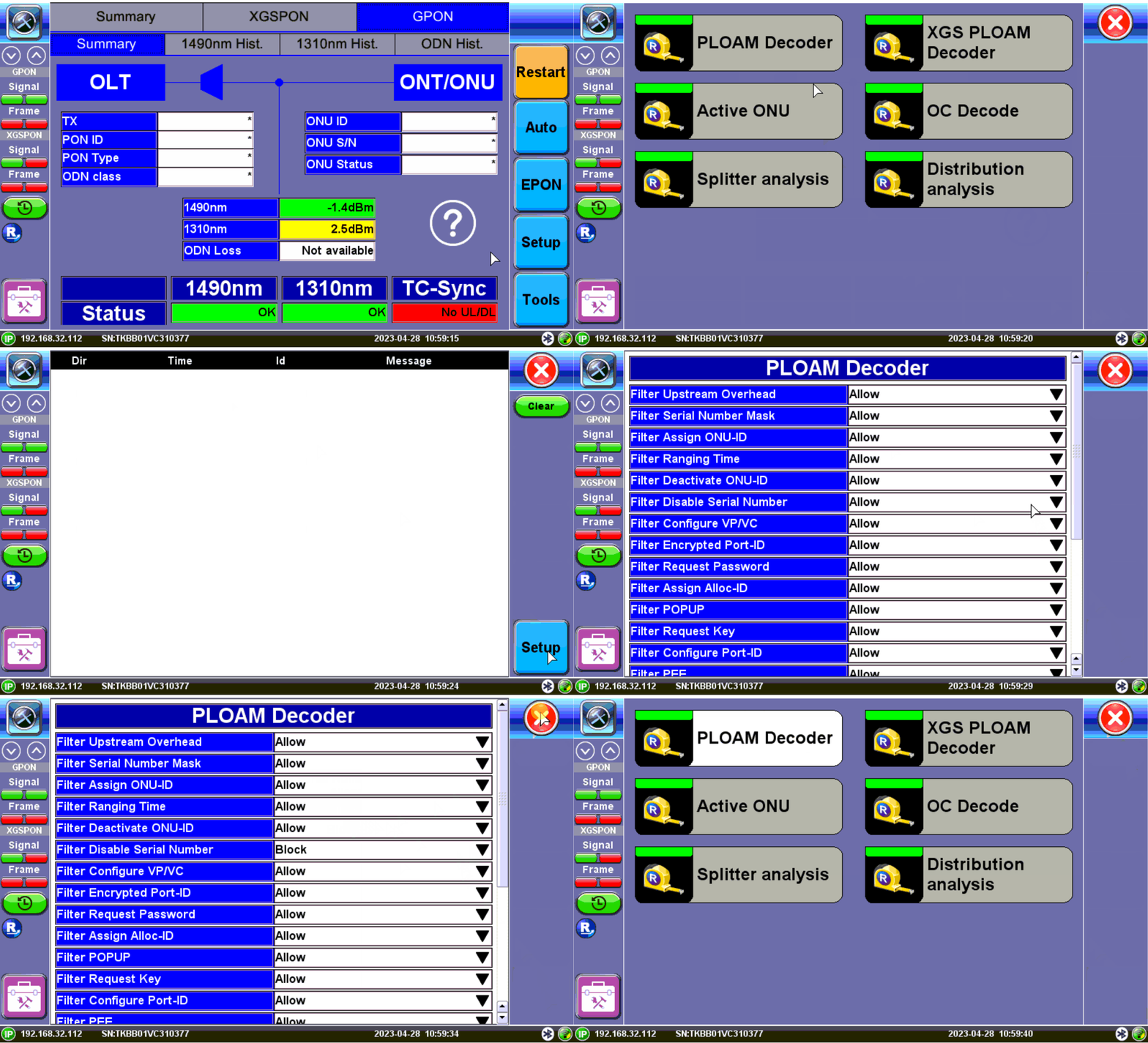
To see a list of PLOAM messages, tap Tools to access the Advanced Tools menu. Then, tap PLOAM Decoder or XGS PLOAM Decoder.
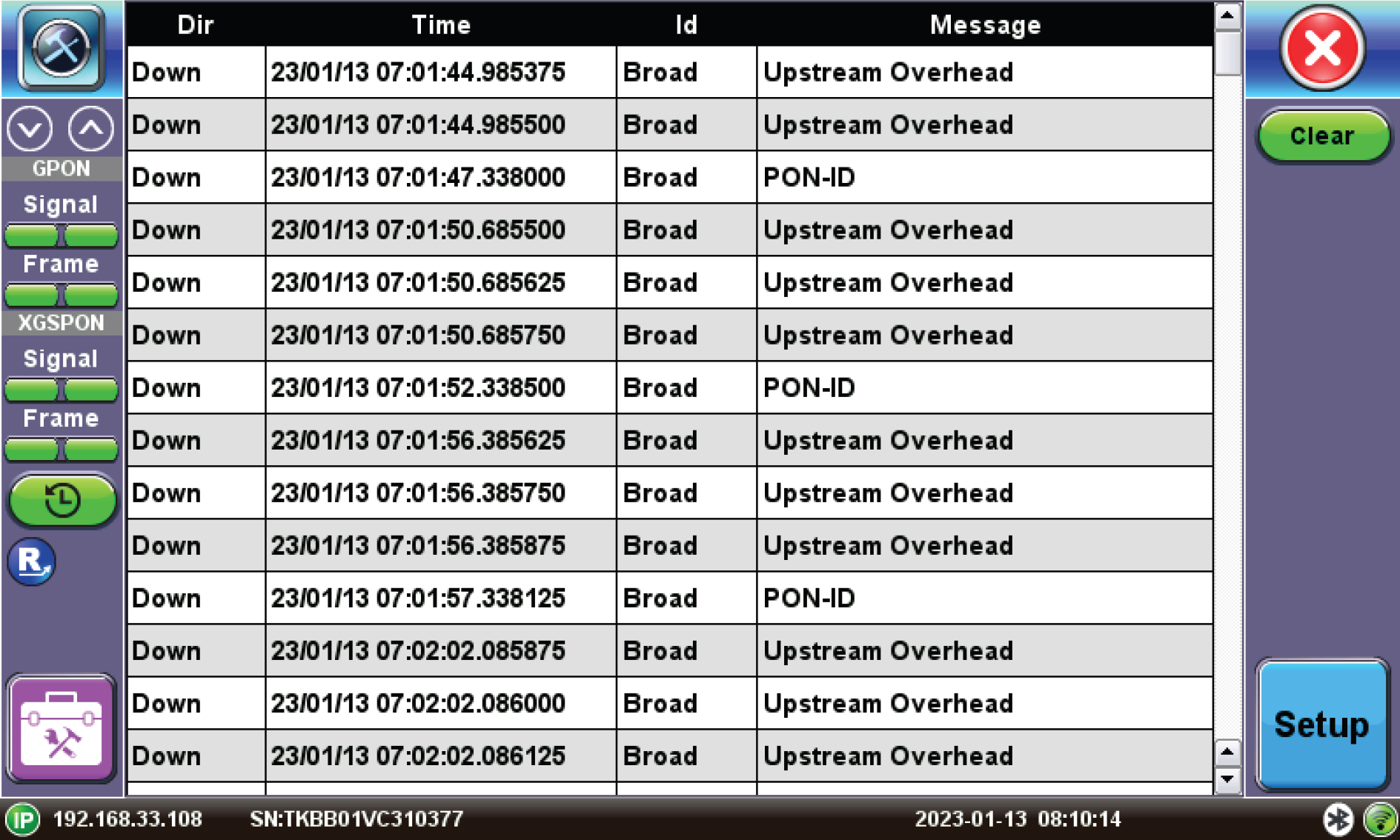
GPON
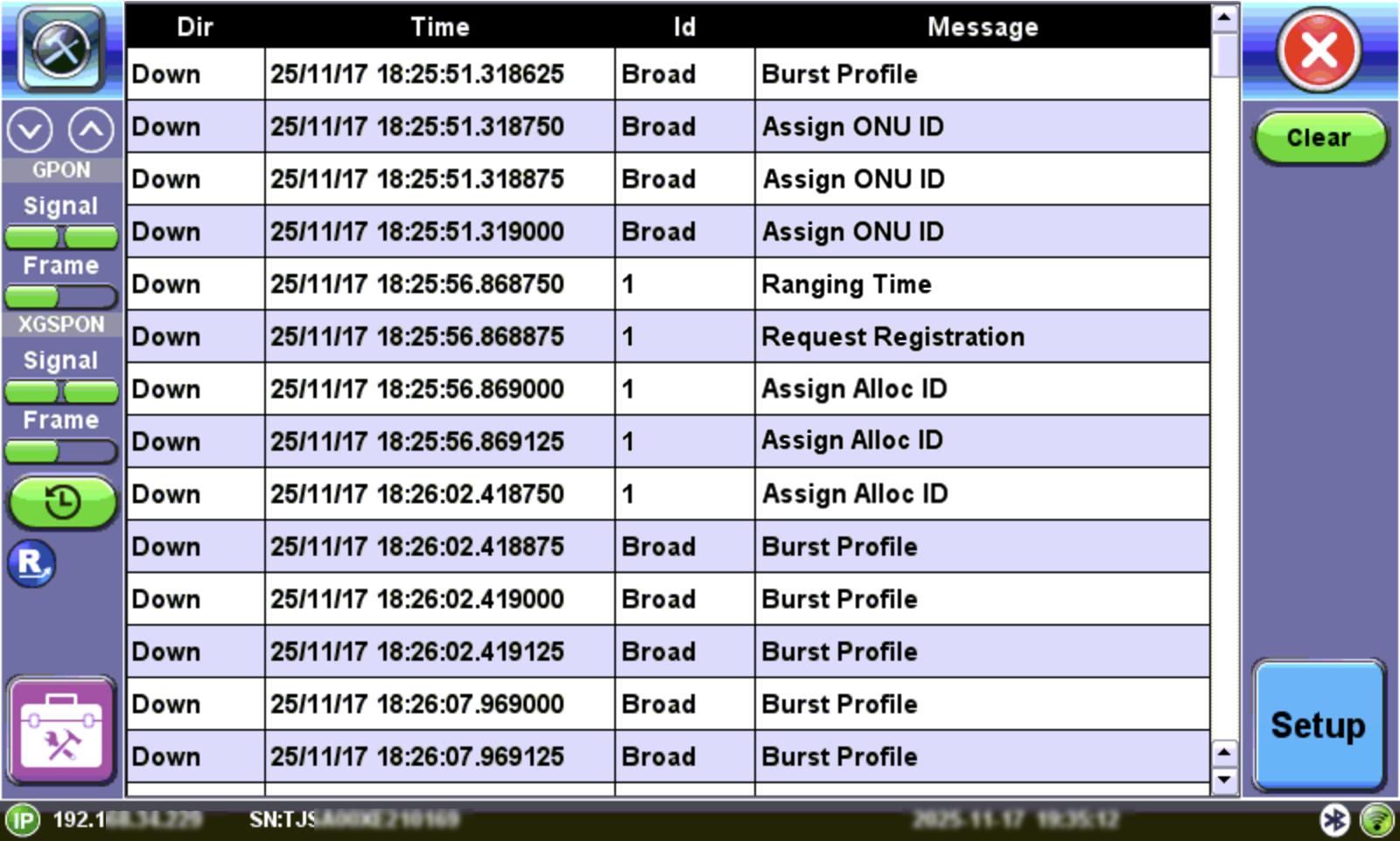
XGS-PON PLOAM Decoder
Use scroll buttons to browse through filtered messages. Tap Clear to reset the message list.
PLOAM messages can be filtered so only ones that are applicable are displayed. For more information on filtering, see PLOAM Decoder Filtering.
Downstream Messages‡
Discovery
-
Upstream_Overhead
-
Serial_Number+Mask
-
Extended_Burst_Length
-
Serial_Number_Response
(Acknowledgement only is shown.)
Registration
-
Assign_ONU-ID
-
Ranging_Time
-
Ranging_Adjustment
Configuration
-
Configure_Port-ID
-
Encrypted_Port-ID
-
Request_Key
(Acknowledgement only is shown.) -
Key_Switching_Time
-
Sleep_Allow
-
Configure_VP/VC
-
PON-ID
Monitoring
-
Physical_Equipment_Error (PEE)
(Acknowledgement only is shown.) -
BER_Interval
-
PST_Message
-
Request_Password
Control
-
Deactivate_ONU-ID
-
Disable_Serial_Number
-
Assign_Alloc-ID
-
Change_Power_Level
POPUP
-
POPUP
-
Swift_POPUP
‡Refer to the latest version of ITU-T G.984.3 and ITU-T G.9807 specifications for a complete list of standard messages.
LOAi Errors
A LOAi (Loss of Acknowledgement) error occurs when the OLT sends a PLOAM message that requires a response from the ONT, but the ONT fails to acknowledge it within an expected time window. The time window is determined by when the OLT expects those acknowledgements (ACKs) to arrive at precise offsets determined by the ranging process and equalization delay.
A scenario of how the FX120 might detect evidence of LOAi Error triggers include captured downstream commands and the absence of corresponding upstream ACKs, followed by deactivation or error-related messages from the OLT, especially if earlier ONT equipment or transmission faults were detected. An FX120 cannot directly detect LOAi errors.
An example would be during ONT activation, the OLT sends a Request_Password or Assign_ONU-ID -ID PLOAM message that requires an acknowledgement from the ONT. The OLT has already ranged the ONT, so it knows exactly when the upstream ACK should arrive in a specific time slot. However, because of a problem at the ONT (e.g., faulty transmitter, low upstream power, or bad burst profile), no ACK is received in that slot. After several retries without a valid ACK, the OLT declares a LOAi condition, flags an error, and may deactivate or block that ONT from progressing to the registered state (stuck in operational yellow mode).
To troubleshoot LOAi Errors, try the following:
-
Inspect and clean fiber connectors.
-
Measure optical power levels at ONT and OLT.
-
Verify ONT status and logs for TX fault alarms.
-
Reboot or replace ONT if necessary.
-
Check OLT configuration and timing parameters.
-
If ONT recovers, re-run ranging and verify burst profile consistency before re-provisioning.
LOAi conditions often show up in the field as an ONT that gets stuck during activation, randomly drop offline, or fail registration without any obvious optical issues. Learning how to recognize and trouble shoot can prevent prolonged service outages.
LOSi Errors
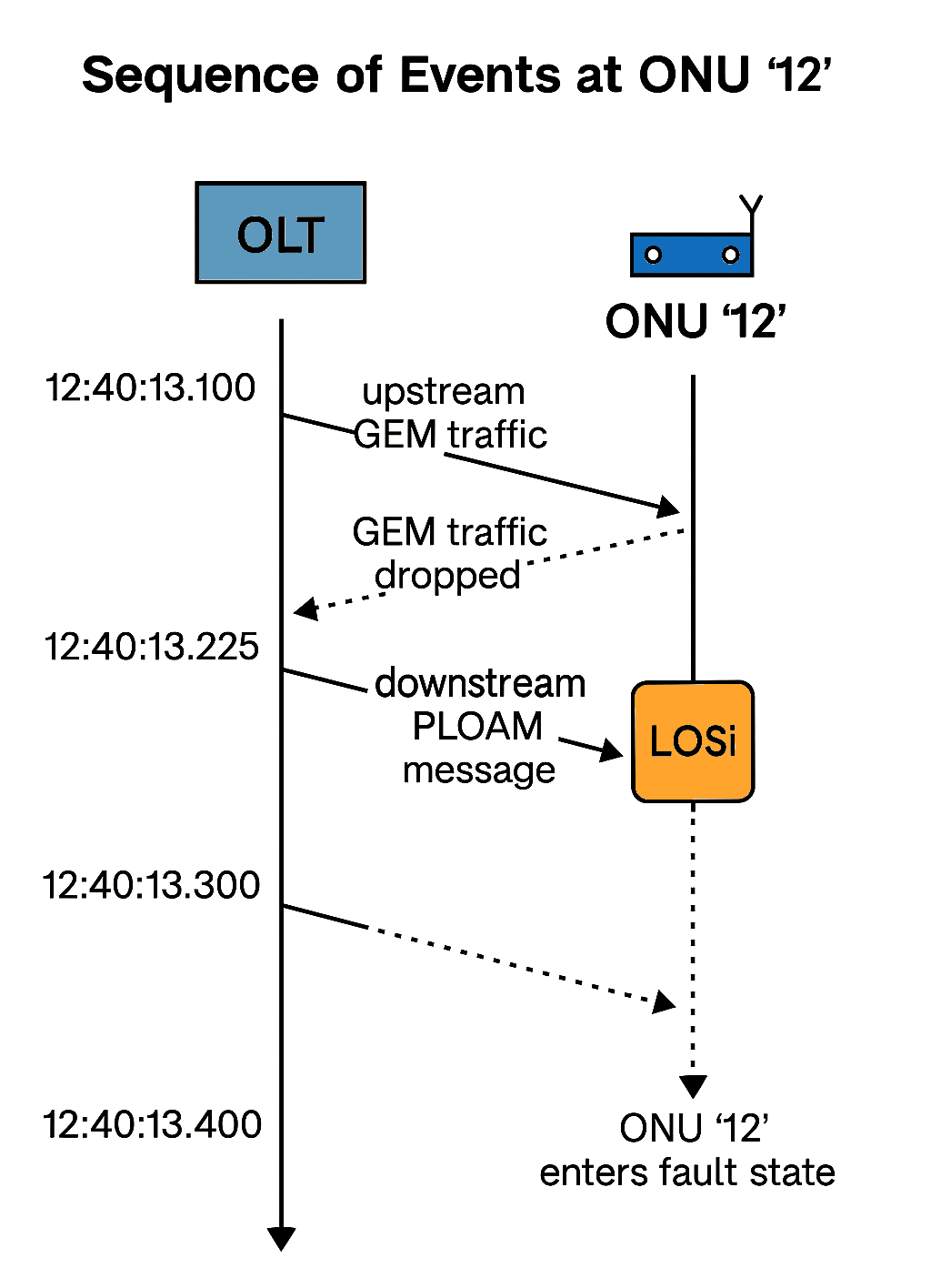
The LOSi is a downstream PLOAM message that is sent by the OLT when it detects that an ONU has stopped transmitting upstream bursts. When the OLT receives no upstream signal from the ONU over multiple expected time slots, the OLT will prompt the ONU to enter a fault or inactive state by sending a DEACTIVATE message. This typically happens due to fiber breaks, severe attenuation, or ONU power loss. LOSi alarms help guide recovery actions and log the fault for diagnostics.
A scenario of how the FX120 might detect evidence of a LOSi message might be triggered is when a field technician disconnects a patch cord at the distribution frame, severing the optical path between the splitter and ONU. The FX120 observes the downstream LOSi message, which indicates that the OLT has detected loss of upstream bursts. The event timeline helps correlate when the OLT declared LOSi relative to observed downstream activity.
In Pass-Through mode, the analyzer may also show a drop in received optical power.
A POPUP message may help to clear a LOSi message once upstream signal is restored.
To troubleshoot LOSi Errors, try the following:
-
Check the downstream logs and note the ONU-ID and timestamp when the LOSi was declared.
-
Verify whether multiple ONUs are affected (suggests feeder fiber issue) or just one (suggests drop fiber issue). A typical root cause is a fiber cut or disconnection.
-
Measure optical power levels at ONT and OLT and compare against thresholds (e.g., GPON: –8 to –28 dBm typical). If power is below the threshold, it may be likely attributed to attenuation, dirty connectors, or fiber damage. Severe attenuation or sudden loss of upstream signal can trigger LOSi.
-
Inspect and clean fiber connectors, check patch cords and splices for continuity, and use an OTDR to locate breaks, bends, or high-loss points in the ODN. (The VeEX OPX-BOXe Mini OTDR can be used with the FX120.)
-
A single ONU LOSi is often preceded by dying gasp. Verify the ONU is powered on and transmitting. Look for DYING_GASP messages that indicate ONU power failure. If the ONU is off, then a LOSi is expected; restore power.
-
Confirm there are no transceiver faults and review OLT logs for upstream burst loss patterns. If LOSi is declared for multiple ONUs simultaneously, it could be a feeder fiber cut or splitter issue and may require hardware replacement.
LOSi conditions provide a formal, standardized alarm mechanism that protects service integrity, synchronizes OLT/ONU fault states, and gives technicians a clear diagnostic signal when the optical path fails. Detecting and troubleshooting LOSi errors helps maintain overall PON stability when one ONU experiences a fault.
PLOAM Decoder Filtering
GPON/XGS-PON PLOAM downstream messages can be filtered to isolate specific message types for analysis and troubleshooting. Filtering downstream PLOAM messages is essential for technicians who need to focus on specific events or commands during PON activation, troubleshooting, or monitoring.
Access the PLOAM Decoder Filtering by selecting the Setup option from the PLOAM Decoder or XGS PLOAM Decoder screen.
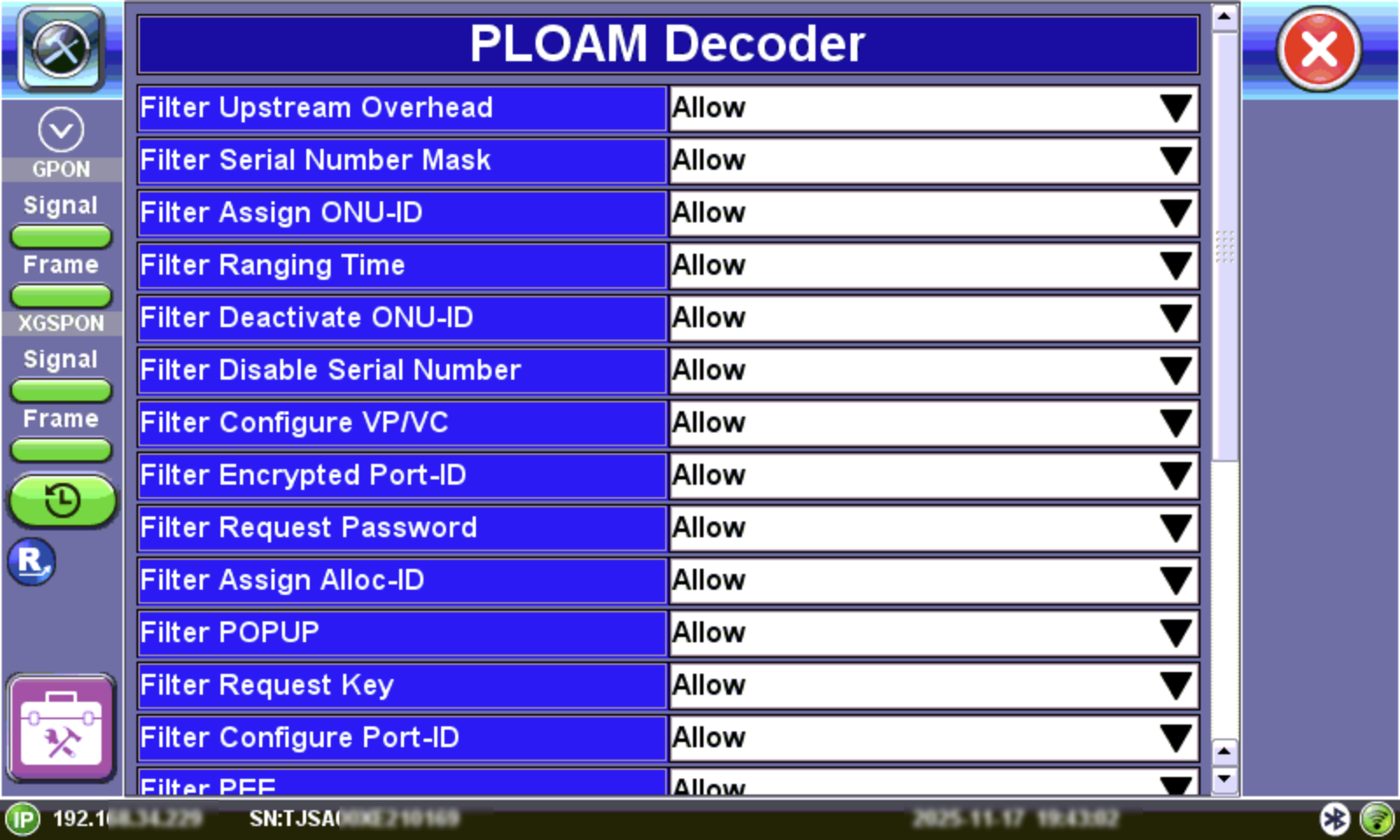
GPON PLOAM Setup
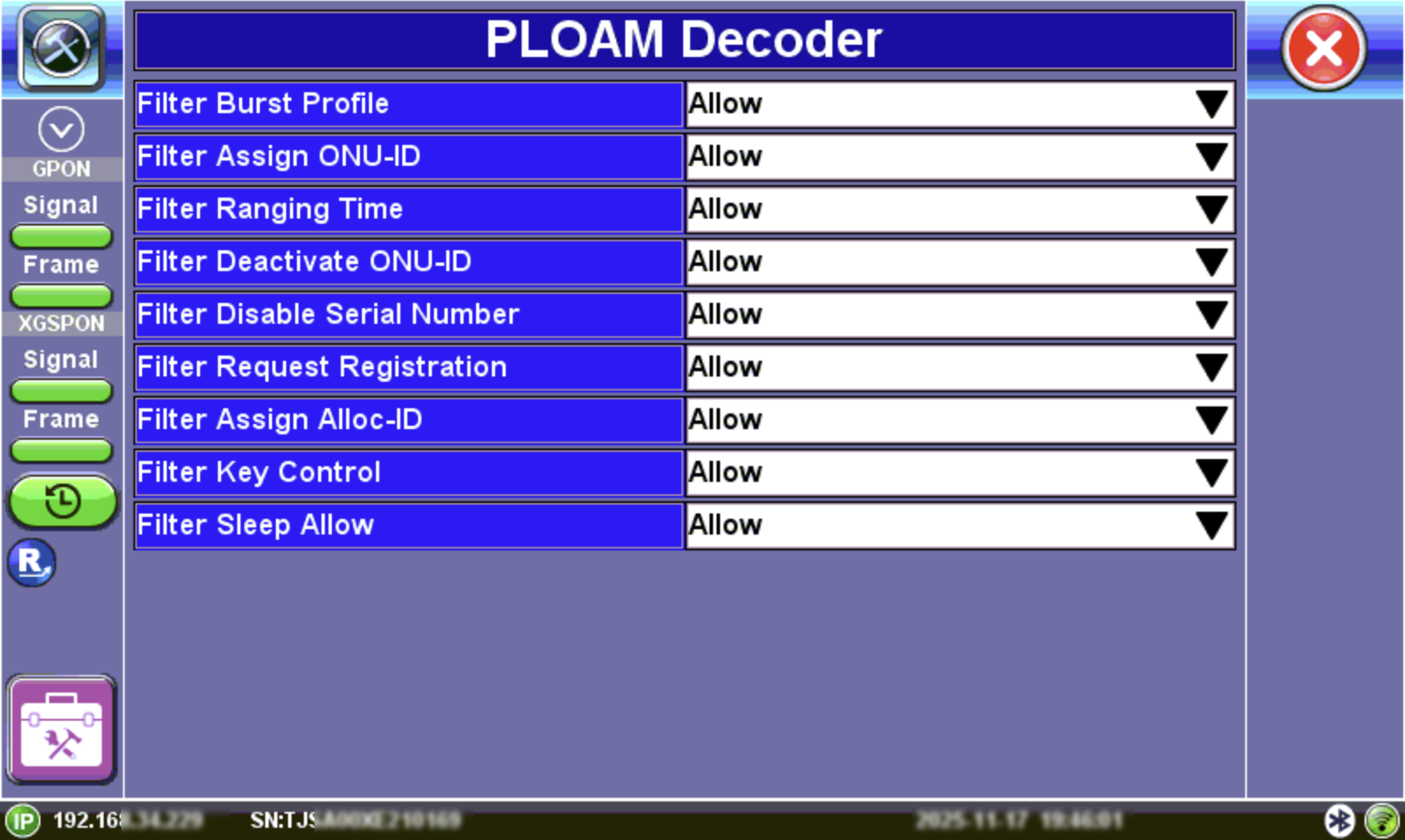
XGS-PON PLOAM Setup
Choose specific message types to display, such as:
-
Serial Number acknowledgements
-
Password
-
Activate/Deactivate ONT