Bidirectional End-to-End Fiber Testing
While ORL measurements showing back reflection caused by back scatter, air gaps, impurities, misalignments, and/or manufacturing imperfections may be different in each direction on the same network, these events are reflective in only one direction with the higher reflective events occurring from the closer end. This interference affects output power, decreases OSNR in analog systems, increases BER (most notably in networks with higher data rates), and can damage the transmitter in severe cases. Thus, ORL measurements in each direction should be considered independent of each other and when both considered, give a better picture of overall fiber health.
Mode Field Diameter (MFD) should also be considered at splice points when testing due to mismatches. These MFD differences can contribute to inaccurate readings when performing unidirectional measurements only. Bidirectional testing can correct some of an OTDR’s inaccuracy due to MFD effects. By averaging loss results from exaggerated losses and gainers in both directions, a more accurate splice and overall loss measurement can be obtained.
FX160 Test Sets in Bidirectional Testing
For bidirectional end-to-end fiber testing, use two FX160 test sets. One acts as a Controller (also known as Device A) to run the tests and gather results, and a Remote one that will be connected at the other end of the fiber (also known as Device B) and can run unattended.
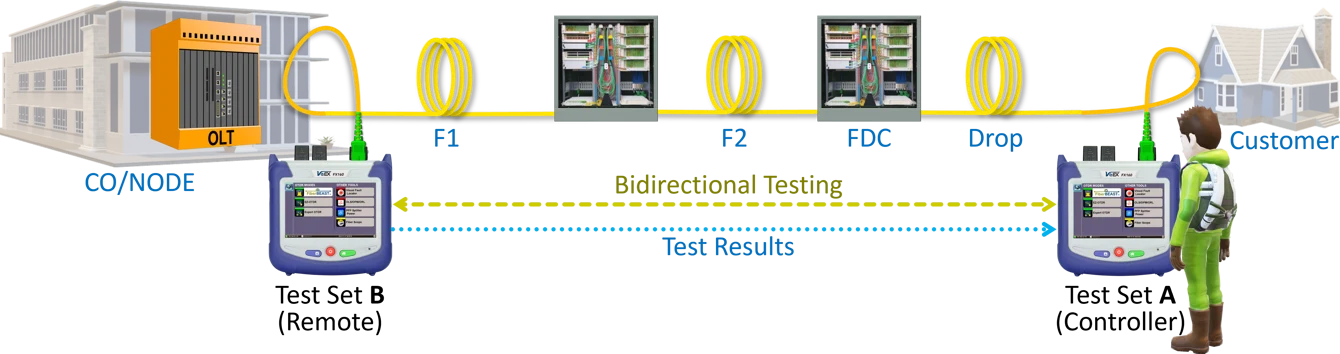
The FX160 automatically pairs with its remote test partner when connected to the fiber link under test. Serial number information and fiber reference values are exchanged before testing starts.
In the setup, select the OLTS, ORL or OTDR option (or any combination thereof), and configure the desired wavelength(s). Prior to testing, Pass/Fail thresholds and reference values can still be modified or edited as needed. A single Start button initiates the test sequence based on the test options selected. The unit initiating the test automatically becomes the Controller and controls communication and test sequence with the remote test set. The FX160 then generates a detailed fiber cable report containing all measurements plus link information. The OLTS and OTDR can be used individually or combined into an automated single button test with one report. Pass/Fail verdicts based on customer thresholds or industry standards, are also provided.
|
|
 Referencing is recommended prior to testing each day or whenever test jumpers or launch cables are changed. It is also recommended to keep both test sets for referencing, before leaving the Remote test set behind. For example, on a PON construction validation test, one can reference and setup the Remote test set, and connect it to an F1 feed, then move to the subscribers' side and use the Controller unit to test all the distribution drops.
The bidirectional automated OLTS measures Insertion Loss (IL), Optical Return Loss (ORL), and Fiber Length. OLTS test results are available in the Link Test tab in both OLTS and FBST screens. Loss in the A-B and B-A directions including average loss are displayed. These bidirectional values help technicians optimize transmission direction. Color coded Pass/Fail messages flag bad fibers and alert the technician to troubleshoot or retest.
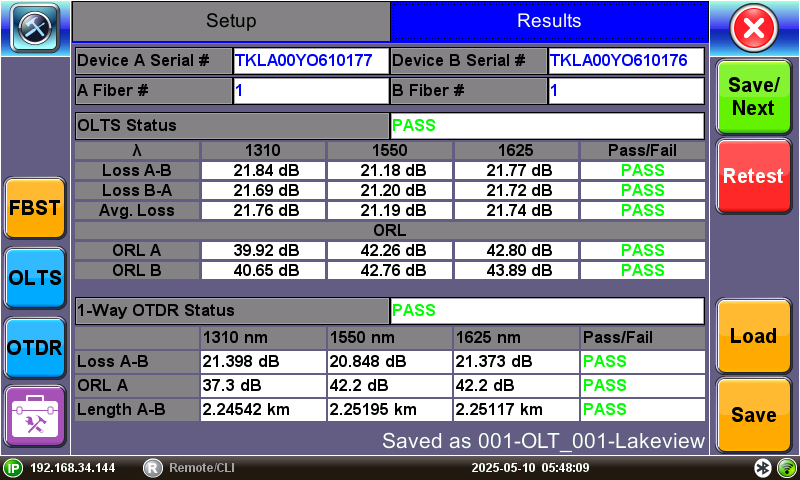
FiberBEAST Results - PASS
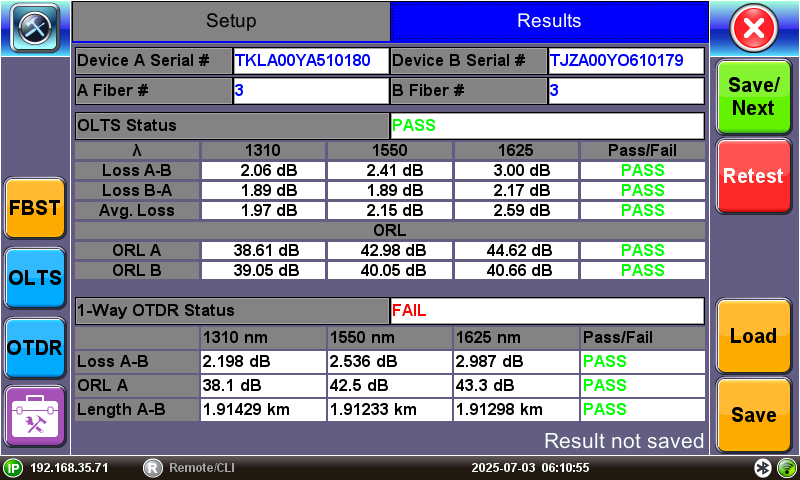
FiberBEAST Results - OTDR FAIL
Point-to-Point Testing (Bidirectional IL/ORL and Bidirectional OTDR)The standard function of the FX160 is for PON/Multi-Point Testing with Bidirectional Insertion Loss and Optical Return Loss combined with Unidirectional OTDR testing for troubleshooting purposes. For Point-to-Point Testing, utilizing the FX160 Bidirectional Insertion Loss and Optical Return Loss may best be used with a Bidirectional OTDR. Two technicians can coordinate to quickly test all fibers between their locations. One technician controls the tests, while the other moves the fibers at the location. Refer to Bidirectional OTDR Testing (X-view). |

|
Do not connect the fiber before opening the application. First, zero the meter with the dust cap closed before making any measurements. |