ONU/ONT Statuses
The test set can report four ONT statuses:
- Registered
- Operational
- Unregistered
- Rogue
Registered (Activated)
When an ONT is registered, it means it has successfully completed the activation process with the OLT and is now officially part of the PON network. During registration, the ONT sends its serial number (and sometimes a password) to the OLT, which then authenticates it, assigns an ONU/ONT ID, and provisions its bandwidth and service parameters. Once this process is complete and the ONT reaches the registered state, it is allowed to send and receive live user traffic. In simple terms, a registered ONT is one that the OLT knows, trusts, and has fully set up to carry service.
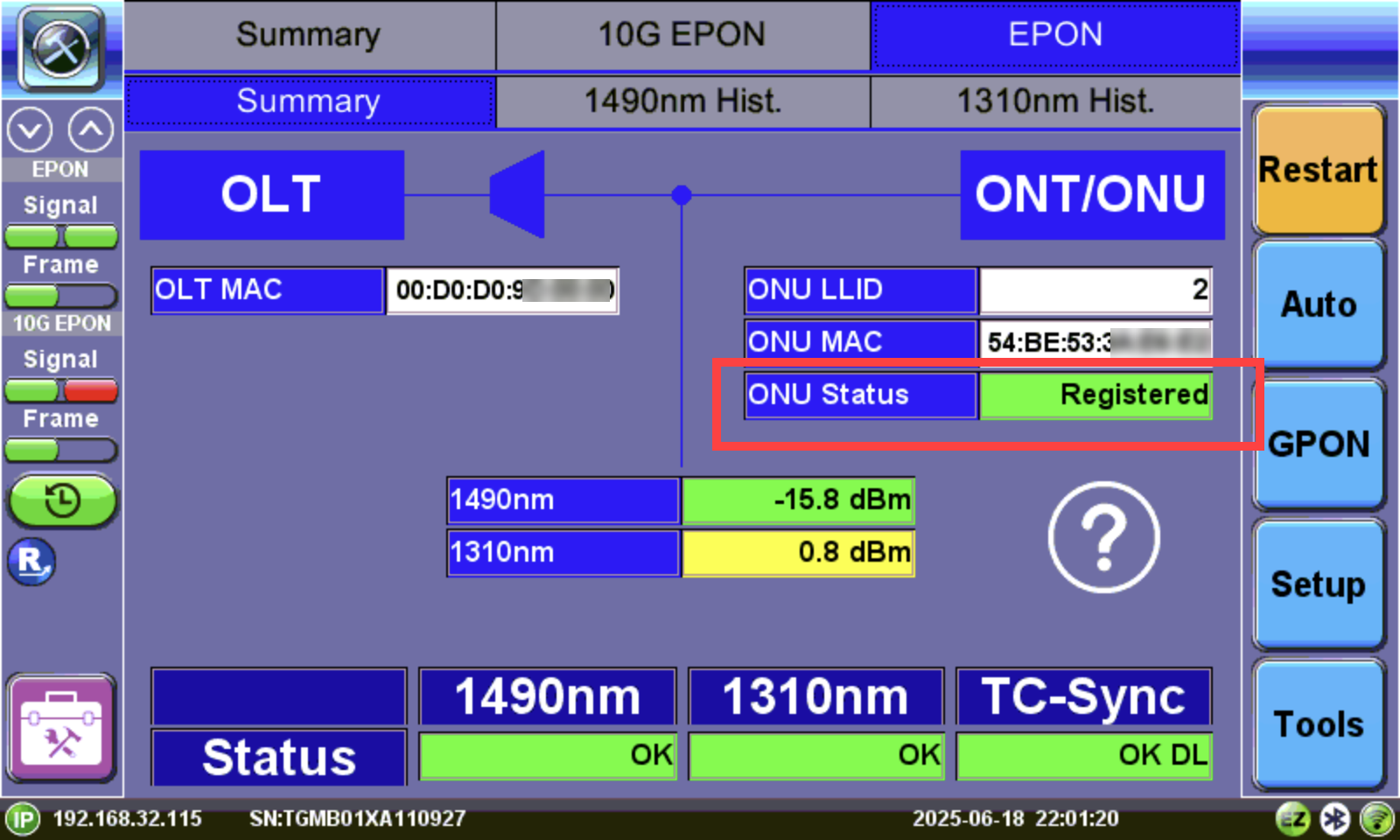
Registered ONU Status on Summary screen
Unregistered (Deactivated)
An unregistered ONT is an ONT that the OLT has not yet accepted or provisioned into the PON network. This can happen when the ONT is newly connected, unknown to the OLT, has the wrong serial number or password, fails authentication, or doesn’t match the expected provisioning profile. It can often be seen as an Unknown or Alien device. In this state, the ONT may send its serial number upstream, but the OLT has not assigned it an ONU/ONT ID and does not allow it to carry user traffic. In short, an unregistered ONT is visible but not authorized or configured to operate on the network.
Examples :
-
If a technician were to connect an EPON ONT or an XGS-PON ONU with a GPON-only OLT.
-
If the ONT SN was never registered to the PON-ID.
In these types of situations, the OLT will send a message that it does not recognize this ONT SN and will request the ONT to disable the SN and deactivate itself.
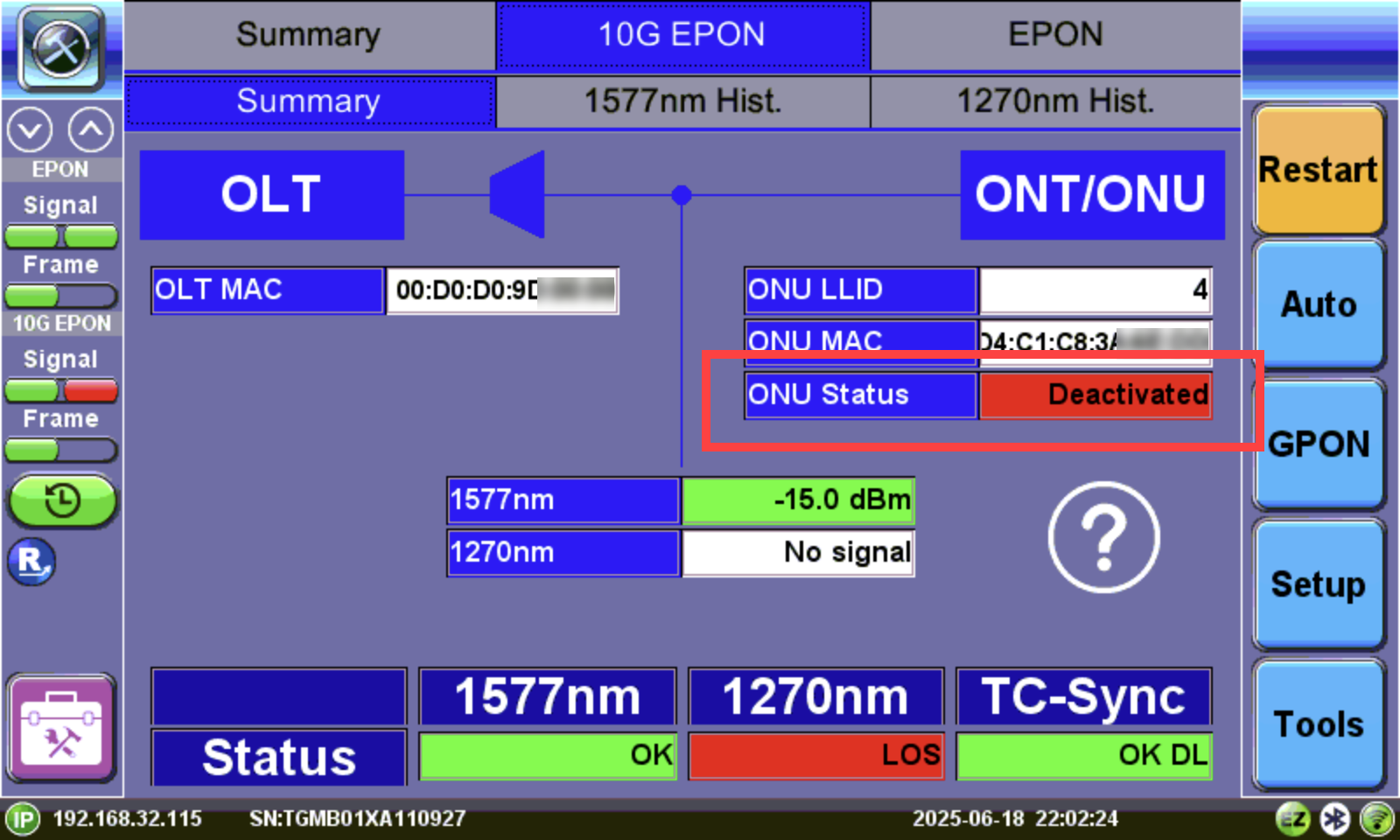
Unregistered/Deactivated ONU Status on Summary screen
Rogue (Alien)
A rogue ONT is an ONT—typically registered—that transmits upstream outside of its OLT-assigned time slot, either intermittently or continuously. Because upstream PON traffic is time-division multiplexed, this unauthorized transmission collides with other ONTs operating within their allocated slots, resulting in burst collisions and service degradation across the PON. Rogue behavior is commonly caused by hardware faults, firmware defects, timing errors, or misconfiguration. In many cases, the rogue ONT itself may appear operational, while other ONTs sharing the same PON experience packet loss, ranging failures, or intermittent service disruption.
Refer to Rogue ONTs for more information on detecting Rogue ONTs.
Operational
Before the process is completed and the ONT is fully active and carrying live service, the ONT may be in an operational state. An ONT in operational state means that it is logically added to the PON and "known" to the network, but not necessarily fully up and passing traffic yet. When you first insert the ONT, you might see a brief flash of yellow before it becomes green indicating full registration. In this sense, the yellow is the brief communication or "handshake" between the ONT and the OLT. The ONT is sending information to the OLT and asking for permission to join the network while the OLT decides if the ONT is qualified. If it stays yellow, it means that the ONT is acknowledged, but there is an issue and it could not fully register.
To see a list of all ONTs/ONUs connected to the OLT, select Tools > Active ONU. Refer to Activated ONT/ONU List.